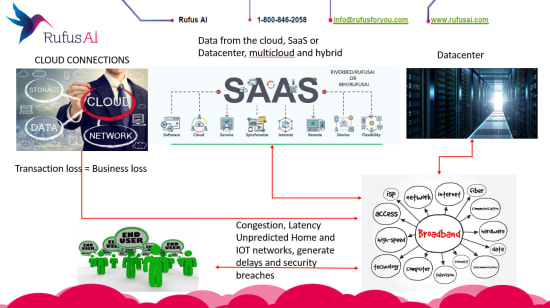
End-users can connect with different options: by cloud (AWS, Microsoft Azure or other cloud providers), by a SaaS solution or from their own datacenter. The next option is Multi Cloud and hybrid - this makes it difficult to find reasons for a performance problem.
Now users have to deal with many options for their network. You have to take into account problems such as latency and congestion, and now an added a new layer because of Covid-19. Normally you work in an office space as an end-user and your network team takes care of all the problems. Now everybody is working from home, and many IOT devices are connected to our home network - are they protected? It is easy for a hacker to use these kinds of devices to enter your office network.
How can we prevent all of this? With a security tool like QRadar or Riverbed. The most important thing to know is that you don't need a APM solution only. Many times, I hear people say, "We have a great APM solution." Well, this is great for application response times, however an enterprise environment has many more components, like the network, load balancers switches and so on. Also, if you're running power machines you have to deal with microcodes and sometimes with HACMP - an APM solution will not monitor this.
Find out what your peers are saying about Datadog, Dynatrace, Splunk and others in Application Performance Monitoring (APM) and Observability. Updated: January 2026.
Hi, in my opinion, because it is still the best at giving you visibility of what's happening in your IT infrastructure, and at detecting threats.
Visibility and detection may seem simple tasks. but actually, they require a lot of capabilities in understanding, integrating, logging, and alarms from a huge multitude of devices. Such tasks go under the line of log ingestion, normalization, etc., and that is far from easy. QRadar has done a lot of work in that direction.
Another aspect is event correlation. And here, either you write the correlation rules yourself, spending $$$$ of professional services, and by the way, it'll take forever to test, implement and maintain up to date, or your access to a very long list of preset correlation rules, that are already available and waiting to be activated.
Finally, visibility and threat detection is just the beginning of a journey pointed at becoming aware of what's happening in your IT and taking relevant and effective action. There are several other technologies that have to be used to minimize exposure, and contain, and remediate relations to an attack. I believe IBM has a few of those, that can be integrated. But whichever you use at the end of this journey, if the original feed is not correct, not relevant, or not complete, you missed your goal in the first place.My 5 cents :)VS
Hello peers,
I am the Senior Vice President for Technology Services at a large logistics company. I am looking for an optimal API solution. Which API tool is better for a hybrid cloud: APIM or Apigee?
Thank you for your help.
Both APIM (Azure API Management) and Apigee are good API Management tools that may be used in a hybrid cloud environment. However, here are some critical differences between the two solutions that may make one a better fit for your specific needs:
APIM (Azure API Management)
Fully managed API Management service that can be deployed on-premises, in Azure, or in a hybrid environment
Offers many features, which include API monitoring, publishing, security, and analytics
APIM is a good choice for organizations seeking a simple, easy-to-use API Management solution.
Apigee
API Management platform that can be deployed on-premises or in the cloud
Offers a broader range of features than APIM, including support for microservices, real-time analytics, and machine learning
Apigee is a good choice for organizations that prefer a more scalable and advanced API Management solution.
Today, Security Information and Event Management (SIEM) solutions play a pivotal role in bolstering organizational defenses against an array of cybersecurity threats. Through the lens of real-world success stories and an evaluation of top SIEM technologies, this comprehensive article illustrates the transformative impact of SIEM systems across industries and highlights leading solutions, includ...
Enterprise Cloud and AI Security Architect at a security firm with 10,001+ employees
Feb 6, 2025
Apart from these, Google Chronicle SIEM is also the best solution for threat hunting and threat detection. We can also use Google Chronicle (Google SecOps) as a SIEM tool and even can be integrated with Mandiant ( third-party tool) for real-time threat intelligence. Google Chronicle is a cloud security service in GCP.
Download our free Application Performance Monitoring (APM) and Observability Report and find out what your peers are saying about IBM, Splunk, Dynatrace, and more! Updated: January 2026.
On top of this Cloud Infrastructure | Oracle is getting into frontline of the SAAS.